
Research Proposal Sample and Format for Pakistani Universities
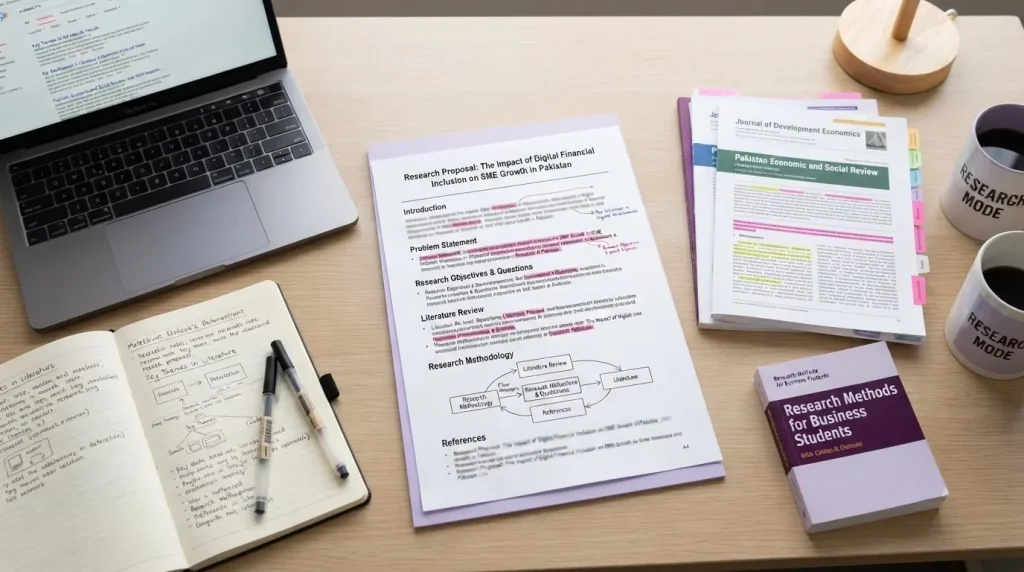
A well-structured research proposal is an important step towards completing an undergraduate or postgraduate research project. It explains what you intend to investigate, why the topic matters, what previous studies have established and how you plan to conduct your research. For students in Pakistan, preparing a proposal can be confusing because universities and departments may follow different guidelines.
This guide provides a research proposal sample, explains the common sections of a research proposal format and presents an illustrative example based on a topic relevant to Pakistani university students. It also explains how requirements may differ between BS, MS, MPhil and PhD programmes.
Whether you need a research proposal sample for an initial university assignment or a detailed proposal for postgraduate research, use this guide as a starting point. Always compare the suggested structure with your department’s latest instructions before submitting your work.
What Is a Research Proposal?
A research proposal is a formal academic document that outlines a research project before the actual study begins. It explains the research problem, objectives, questions, relevant literature and proposed methodology. It also gives supervisors or research committees an opportunity to assess whether the proposed study is relevant, manageable and academically sound.
A proposal is a plan for research, not a report of completed research. It describes what you intend to investigate and how you expect to investigate it. You should therefore avoid presenting proposed methods or expected outcomes as if the research has already been completed.
Research Proposal vs Research Paper vs Thesis vs Dissertation
These terms are related but refer to different academic documents.
| Document | Main purpose |
|---|---|
| Research proposal | Presents a plan for a future research study |
| Research paper | Presents an argument, analysis or findings on a particular topic |
| Thesis | A substantial research document submitted to meet the requirements of an academic degree; terminology varies by institution |
| Dissertation | A substantial research project, commonly associated with doctoral study in some education systems; usage varies between countries and universities |
A research proposal usually comes before the research paper, thesis or dissertation. It helps establish the direction and scope of the study before the researcher begins the main research work.
Research Proposal Format for Pakistani Universities
There is no single research proposal format that applies to every university in Pakistan. Requirements can differ according to the institution, department, academic programme, research discipline and supervisor. For example, a social sciences proposal may require a detailed sampling strategy, while a proposal in computer science may need a technical framework or system design.
However, many research proposals contain the following sections. Treat this as a general structure and adjust it according to your university’s official template.
Common Research Proposal Format
| Section | What to include |
|---|---|
| Title page | Proposed research title, student name, registration number, department, university and supervisor details |
| Abstract or research summary | A brief overview of the research problem, objectives and proposed methodology, if required |
| Introduction and background | Context of the topic and the issue you intend to investigate |
| Problem statement | A clear explanation of the research problem |
| Research gap | What existing studies have not adequately addressed |
| Research objectives | Specific outcomes the study intends to achieve |
| Research questions | Questions the study aims to answer |
| Hypothesis | Testable statements, where relevant to the research design |
| Literature review | Discussion of relevant academic studies and existing knowledge |
| Research methodology | Research approach, design, data sources, sampling and analysis methods |
| Population and sampling | Target population, sample size and sampling technique, where applicable |
| Data collection | Proposed instruments or procedures for collecting information |
| Data analysis | Methods or tools planned for analysing the data |
| Significance of the study | Academic, practical or policy value of the research |
| Scope and limitations | Boundaries and possible limitations of the study |
| Ethical considerations | Consent, confidentiality, privacy and other relevant ethical issues |
| Expected outcomes | Anticipated contribution or possible findings, without presenting them as established results |
| Timeline | Estimated schedule for completing research activities |
| References | Sources cited in the proposal, following the required referencing style |
Not every proposal needs all these sections. Your department may combine some sections, use different headings or require additional components such as a conceptual framework, theoretical framework, budget or appendices.
1. Title Page
The title page identifies the proposed study and its researcher. It commonly includes:
- Proposed research title
- Student’s full name
- Registration or roll number
- Degree programme
- Department and university
- Supervisor’s name
- Submission date
Use the title-page layout provided by your university if one is available. Do not assume that a general APA title page will automatically meet your department’s requirements.
2. Introduction and Background
Introduce the research topic and provide enough context for readers to understand the issue. Explain the background of the subject, its relevance and the specific area your research will examine.
Avoid making broad claims without evidence. Use relevant academic publications, reliable reports and recent studies to establish the context.
3. Problem Statement and Research Gap
The problem statement identifies the issue that your research intends to investigate. It should be specific enough to show what is wrong, unknown or insufficiently understood.
The research gap explains what is missing from existing research. For example, previous studies may have examined a topic in other countries, while limited research has focused on a particular population or setting in Pakistan.
A research gap should be supported by your review of relevant literature rather than simply claiming that no research exists.
4. Research Objectives and Questions
Research objectives describe what the study intends to achieve. Research questions identify what the study will investigate.
Make sure both are aligned. If your study has three main objectives, your research questions should address those objectives clearly. Avoid adding questions that your proposed methodology cannot answer.
5. Literature Review
The literature review discusses relevant academic research and explains how your proposed study relates to existing knowledge. It should compare findings, identify patterns and highlight areas that need further investigation.
Do not simply list summaries of different articles. Organise the literature around themes, concepts or research issues.
For more detailed guidance, read our guide on how to write a literature review.
6. Research Methodology
The methodology explains how you plan to conduct the study. Depending on the topic, it may cover:
- Research approach: qualitative, quantitative or mixed methods
- Research design: descriptive, exploratory, correlational, experimental or another suitable design
- Target population and sampling method
- Proposed sample size and justification
- Data collection instruments, such as questionnaires or interviews
- Data analysis techniques
- Ethical considerations
Your selected methods should be appropriate for your research questions and objectives. For example, a questionnaire-based study may be suitable for measuring patterns across a defined student population, while interviews may be more appropriate for exploring individual experiences in depth.
7. Significance, Scope and Limitations
Explain why the proposed research matters and who may benefit from its findings. The significance may be academic, practical, professional or policy-related.
The scope defines what the study will and will not cover. Limitations identify possible constraints, such as restricted access to participants, limited time or a particular geographical focus.
8. Timeline and References
A research timeline divides the project into manageable activities, such as literature review, proposal approval, data collection, analysis and final writing.
The references section lists the sources cited in the proposal. Use the referencing style required by your department. APA 7 is used in many academic settings, but it should not be assumed to be compulsory for every Pakistani university or discipline.
Research Proposal Sample: Illustrative Example
The following research proposal sample demonstrates how selected sections can be organised. It is an illustrative academic example, not an approved university submission or a complete proposal ready for direct submission. The research design, sample, references and other details would need to be developed and verified for an actual study.
Sample Research Topic
Impact of Social Media Usage on Academic Performance Among University Students in Pakistan
1. Introduction and Background
Social media platforms have become an important part of communication, information sharing and everyday student life. University students use these platforms to interact with classmates, access educational resources, discuss academic topics and stay connected with different communities. However, frequent use may also create distractions and affect time management and study routines.
Research published in Pakistan has examined the relationship between social media use and students’ academic experiences. For example, Junejo, Hussain and Lashari (2022) investigated social media usage among university students and its relationship with academic performance, learning attitudes and subjective wellbeing. A later study by Sadia, Babar and Ghaffar (2025) examined time spent on social media and academic performance among students at the University of Sargodha.
This proposed study would explore the relationship between social media usage and academic performance among university students in a clearly defined Pakistani university setting.
2. Problem Statement
Although social media can provide opportunities for academic communication and access to information, excessive or poorly managed use may interfere with students’ study routines. Students may spend time on social networking platforms during study hours, experience distractions or find it difficult to balance online activities with academic responsibilities.
The proposed research will investigate how social media usage relates to academic performance among the selected university student population. It will consider patterns of use and students’ reported academic experiences rather than assuming that social media has the same effect on every student.
3. Research Objectives
The proposed study aims to:
- Examine the pattern of social media usage among university students.
- Explore the relationship between social media usage and academic performance.
- Identify how students perceive the influence of social media on their study routines.
- Examine whether study-related and non-study-related social media use have different associations with academic performance.
4. Research Questions
- What are the common patterns of social media usage among the selected university students?
- What relationship exists between social media usage and academic performance?
- How do students perceive the influence of social media on their study routines?
- Does the purpose of social media usage relate differently to students’ academic performance?
5. Hypothesis
If the study adopts a quantitative design, a possible hypothesis could be:
H1: There is a statistically significant relationship between social media usage and academic performance among the selected university students.
H0: There is no statistically significant relationship between social media usage and academic performance among the selected university students.
These hypotheses are examples only. They should be refined after defining the variables, reviewing relevant literature and selecting an appropriate research design.
6. Brief Literature Review
Existing research provides a basis for examining social media use in higher education. Junejo, Hussain and Lashari (2022) studied 254 university students and reported relationships between social media use, academic performance, learning attitudes and subjective wellbeing.
Sadia, Babar and Ghaffar (2025) investigated the relationship between time spent on social media and academic performance among 122 university students at the University of Sargodha. Their study used a quantitative approach and a structured questionnaire.
These studies provide relevant Pakistani research examples. The proposed study would need to review additional literature and identify a specific research gap, such as a different university setting, student group, platform-use pattern or research variable.
7. Proposed Research Methodology
The study could use a quantitative research approach with a survey-based design. The target population would consist of students enrolled at the selected university in Pakistan.
A suitable sampling technique and sample size would be determined according to the defined population, research objectives, available access and departmental requirements. Data could be collected through a structured questionnaire covering social media habits, study routines and relevant academic-performance indicators.
The collected data could then be analysed using suitable statistical techniques. The final choice of analysis would depend on the research questions, measurement scales and data characteristics.
Participation should be voluntary. The researcher should explain the purpose of the study, obtain informed consent and protect participants’ personal information.
8. Expected Outcomes
The study is expected to provide a clearer understanding of social media usage patterns among the selected university students and how these patterns relate to their academic experiences. It may also identify differences between academic and non-academic uses of social media.
These are anticipated areas of investigation, not confirmed findings. Actual conclusions can only be drawn after collecting and analysing the research data.
9. Sample References
Junejo, H. K., Hussain, N., & Lashari, A. R. (2022). Social media usage among university students and its impact on academic performance, learning attitudes and subjective wellbeing. Pakistan Social Sciences Review, 6(2), 678–688. https://doi.org/10.35484/pssr.2022(6-II)57
Sadia, H., Babar, M. H., & Ghaffar, Z. (2025). Time spent on social media and its impact on academic performance: Evidence from university students in Sargodha, Pakistan. Pakistan Social Sciences Review, 9(4), 285–297. https://doi.org/10.35484/pssr.2025(9-IV)22
These references are included to demonstrate how relevant studies can be cited. A complete proposal should include all sources actually consulted and cited in its literature review.
How to Write a Research Proposal Step by Step
A clear writing process can help you develop a focused proposal and avoid unnecessary revisions.
Step 1: Select a Research Topic
Choose a topic related to your academic discipline and research interests. It should be specific, researchable and suitable for your degree level.
Before finalising the topic, consider whether relevant literature is available, whether you can access the required data and whether the proposed study can be completed within your available time.
Step 2: Identify the Research Problem
Define the issue you want to investigate. Read relevant journal articles, previous theses and academic publications to understand what is already known.
Your problem statement should explain the issue and lead naturally to the research gap.
Step 3: Develop Objectives and Questions
Write clear objectives that describe what the research will achieve. Convert those objectives into research questions that can be answered through your proposed study.
Keep the scope realistic. Too many objectives can make a project difficult to manage.
Step 4: Review Existing Literature
Search academic databases, university repositories and credible journals for relevant studies. Compare their research methods, findings and limitations.
Use this review to establish the academic background of your topic and explain why your proposed study is worth conducting.
Step 5: Choose a Suitable Methodology
Select a research approach and design that can answer your research questions. Explain your proposed population, sampling strategy, data collection methods and analysis techniques.
If you need help understanding research methods, explore our research methodology guidance.
Step 6: Prepare the Timeline and References
Break the project into realistic stages and estimate how long each stage will take. Include the literature review, proposal approval, data collection, analysis and final writing where relevant.
Check every in-text citation against your reference list. Make sure the required referencing style is applied consistently.
For a more detailed walkthrough, you can also read how to write a research proposal.
Research Proposal Requirements for BS, MS, MPhil and PhD Students
The expected depth of a research proposal generally depends on the academic programme and the research task. However, there is no universal rule that every Pakistani university applies in exactly the same way.
| Academic level | General proposal expectations |
|---|---|
| BS / Undergraduate | A focused topic, clear problem, objectives, relevant literature and a manageable methodology, where a proposal is required |
| MS | A more developed research problem, stronger engagement with existing literature and a clearly justified methodology |
| MPhil | A well-defined research gap, critical literature review, clear research questions and a detailed research design |
| PhD | A substantial and original research direction, strong theoretical or conceptual grounding, a defensible methodology and a clear contribution to knowledge |
These are broad academic expectations, not a substitute for institutional rules. Some undergraduate programmes may require only a short research outline, while others may have a formal proposal assessment. Postgraduate requirements can also differ in structure, length, presentation and approval procedures.
The Higher Education Commission’s Graduate Education Policy 2023 provides a national policy framework for graduate education. Universities also publish their own rules and procedures. For example, the University of Turbat makes its graduate rules and regulations available through its official website.
Before preparing your final document, check:
- Your university’s latest graduate or research regulations.
- Your department’s proposal template or prescribed format.
- Your supervisor’s instructions.
- Any research committee or departmental submission requirements.
- The required referencing style and research ethics procedure.
Research Proposal Formatting Guidelines
A proposal’s presentation should be clear, consistent and easy to read. However, formatting instructions are not identical across all universities.
The following points can help you prepare a professional document, but your institution’s template should take priority.
| Formatting element | What to check |
|---|---|
| Font and size | Use the font and size prescribed by your university |
| Line spacing | Follow the required spacing, such as 1.5 or double spacing |
| Margins | Apply the margins specified in the official template |
| Page size | Confirm whether A4 or another page size is required |
| Headings | Use a consistent heading hierarchy |
| Page numbers | Follow the university’s page-numbering instructions |
| Referencing | Apply the required style consistently, such as APA 7 where specified |
| Tables and figures | Give each table or figure a clear title and follow the required numbering style |
| Word count | Stay within the department’s stated limit |
If your department requires APA 7, consult the official APA Style title-page guidance and follow the relevant rules for citations and references. Do not apply APA formatting automatically if your university requires another style or a customised template.
Common Research Proposal Mistakes to Avoid
A proposal can lose clarity and academic strength when its sections are poorly connected or its research plan is unrealistic. Avoid these common mistakes:
- Choosing an overly broad topic: Narrow your subject to a specific issue, population or setting.
- Writing an unclear problem statement: Explain the actual problem rather than relying on general background information.
- Claiming a research gap without evidence: Review relevant studies before stating what is missing.
- Using unrelated literature: Include sources that directly support your topic, variables and research direction.
- Misaligning objectives and questions: Make sure each research question connects to an objective.
- Selecting an unsuitable methodology: Choose methods that can realistically answer your research questions.
- Ignoring ethical considerations: Address consent, confidentiality and data protection where relevant.
- Using inconsistent references: Check citations, reference details and formatting carefully.
- Ignoring university instructions: A well-written proposal may still need revision if it does not follow the department’s required structure.
- Presenting expected outcomes as actual findings: A proposal describes planned research, not results from a study that has not yet been conducted.
Tips for Preparing a Strong Research Proposal
- Choose a topic that is relevant to your discipline and manageable within the available time.
- Read recent and credible academic research before finalising your research gap.
- Use precise language and avoid unnecessary background information.
- Keep your objectives specific and your research questions answerable.
- Explain why your selected methodology is suitable.
- Use reliable academic sources rather than unsupported online claims.
- Check the proposal against your university’s official guidelines.
- Ask your supervisor for feedback before final submission.
- Proofread the complete document for clarity, grammar, consistency and referencing.
Where to Find Research Proposal Samples and University Guidelines
When searching for a research proposal sample PDF or template, prioritise official and academically reliable sources. A sample can help you understand the structure, but it should not replace your department’s current instructions.
Useful places to look include:
1. Higher Education Commission (HEC): Check official HEC policies and notifications relevant to your programme, particularly for graduate education.
2. University websites: Visit your university’s official department, graduate studies office, research office or examination section. These may provide proposal templates, submission instructions and research regulations.
3. Academic journals: Published research articles can help you understand how researchers develop research questions, review literature and explain methodology. They are examples of completed studies, not necessarily proposal templates.
4. Google Scholar: Use academic search results to locate relevant journal articles, books and other scholarly publications.
5. University repositories: Institutional repositories may contain previous theses and research documents. Use them to understand academic organisation and referencing, while respecting copyright and academic integrity.
6. ResearchGate: It may help you discover research publications and author profiles. Verify the publication details through the original journal or publisher before citing a source.
When using any research proposal example PDF, check its publication date, institution, academic level and subject area. An older sample or a template from another university may not meet your current department’s requirements.
Research Proposal Preparation Checklist
Before submitting your proposal, review the following checklist:
- The research title is specific and relevant.
- The introduction provides sufficient background.
- The problem statement clearly identifies the issue.
- The research gap is supported by relevant literature.
- The objectives and research questions are aligned.
- The literature review includes relevant academic sources.
- The methodology explains how the research will be conducted.
- The proposed sampling and data collection methods are appropriate.
- Ethical considerations have been addressed where required.
- The timeline is realistic.
- All citations appear in the reference list.
- The document follows the university’s latest formatting instructions.
- The proposal has been reviewed for clarity, grammar and consistency.
Frequently Asked Questions
1. How do I write a research proposal for a Pakistani university?
Start by selecting a focused research topic and identifying a clear problem. Develop research objectives and questions, review relevant literature and explain your proposed methodology. Then organise the document according to your university’s required format and check it with your supervisor before submission.
2. Where can I find a research proposal sample PDF?
You can look for samples and guidelines on official university websites, graduate studies pages, research offices and academic repositories. Published journal articles can also help you understand research structure and methodology. Always confirm that a sample is relevant to your subject and academic level.
3. Is there a standard research proposal format in Pakistan?
There is no single detailed format that applies to every Pakistani university and discipline. Many proposals include an introduction, problem statement, objectives, research questions, literature review, methodology and references, but the exact sections and formatting requirements may vary.
4. How many pages should a research proposal be?
The required length depends on your university, department, degree programme and research topic. Some institutions prescribe a specific page or word limit, while others provide a proposal template. Follow the official instructions rather than relying on a general page count.
5. Can I use a research proposal template for my university submission?
Yes, a template can help you organise your work, but it should only be used if it matches your department’s current requirements. Check the headings, formatting, referencing style and any additional sections required by your supervisor or research committee.
6. What is the difference between a research proposal sample and a research proposal format?
A research proposal sample is an example of how a proposal may be written. A research proposal format explains the sections and order in which information should be presented. A template provides a reusable structure with headings or spaces to complete. All three can be useful, but none should replace your university’s official instructions.
Get Academic Guidance for Your Research Proposal
Preparing a research proposal requires more than filling in headings. Your topic, research problem, objectives, literature review and methodology should work together to create a clear and academically sound research plan.
Quick Assignment Help provides academic guidance for college and university students who need support with research planning, proposal structure, literature review development, methodology and academic editing.
If you need guidance with your research topic or proposal draft, explore our research proposal writing support. Share your subject, academic level and university requirements so that the appropriate support can be discussed.