
HEC Plagiarism: What the 19% Similarity Index Means for Your Thesis

When preparing a thesis or research paper, understanding the Higher Education Commission’s (HEC) plagiarism guidelines is essential. One requirement that often causes confusion among research students is the HEC 19% similarity index. Students may assume that a similarity score below 19% automatically means their work is acceptable, while a higher score always proves plagiarism. However, the HEC Anti-Plagiarism Policy provides a more detailed approach.
According to the HEC Anti-Plagiarism Policy Version 2.0, August 2023, a 19% similarity index is an indicator that requires academic attention; it is not, by itself, a final decision about plagiarism. The policy also discusses individual-source matches and similarity in the findings and conclusion sections.
This guide explains what the HEC plagiarism policy says, how to interpret a similarity report, and what thesis students should consider before submission.
What Is the HEC Similarity Index?
The HEC similarity index refers to the percentage of text in an academic document that matches material available in the databases used by plagiarism detection software. These matches may come from published research papers, online sources, academic publications, student submissions and other indexed documents.
A similarity report identifies matching text and shows where those matches appear. It helps supervisors and academic institutions review the originality of a thesis, dissertation or research paper.
However, similarity and plagiarism are not the same thing. A matching passage may be a correctly cited quotation, a reference entry, a commonly used academic expression or material that requires further investigation. The percentage alone cannot establish whether academic misconduct has occurred.
The HEC policy therefore treats the similarity index as a guideline for identifying possible plagiarism rather than conclusive proof of it.
For the complete requirements, students can consult the official HEC Anti-Plagiarism Policy 2023.
What Does the HEC 19% Similarity Index Mean?
The HEC 19% similarity index is an important reference point for reviewing assignments, thesis and research papers across academic disciplines.
Under Annexure 3, Point 11 of the HEC Anti-Plagiarism Policy 2023, a similarity index of 19% is indicative of the possibility of plagiarism. This means that a document reaching or exceeding this level may require closer examination by the relevant academic experts.
The policy also provides that when the overall similarity index is 19% or below, the author may receive the benefit of doubt. However, this does not mean every document below 19% is automatically approved.
Other conditions still need to be considered, particularly the percentage of similarity from an individual source and the nature of the matching material.
For example:
- A thesis with an overall similarity score of 15% may still require investigation if a substantial portion comes from one source.
- A thesis with a score of 19% may contain properly cited quotations and references that need to be reviewed in context.
- A thesis with a score above 19% may require further assessment to determine whether the matches represent plagiarism or legitimate academic material.
Therefore, students should not focus exclusively on achieving a particular percentage. They should ensure that their research is properly referenced, independently developed and consistent with their university’s academic requirements.
Other HEC Similarity Conditions for Thesis
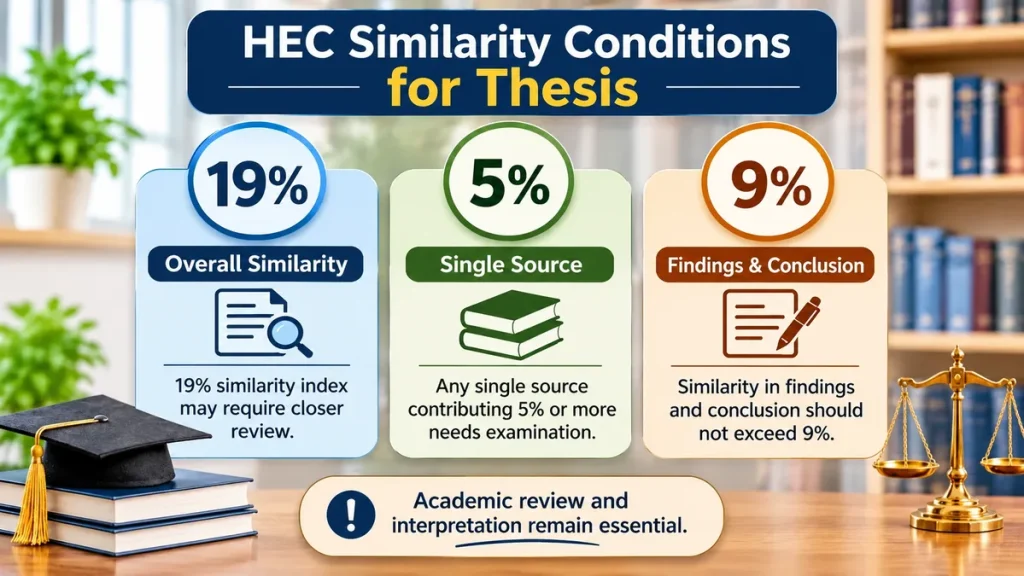
The HEC Anti-Plagiarism Policy outlines additional similarity requirements beyond the overall 19% index. It states that similarity in the findings and conclusion sections should not exceed 9%. It also requires closer examination of any individual source contributing 5% or more to the overall similarity report, as this may indicate potential plagiarism.
1. The 5% Individual-Source Condition
The HEC policy identifies an individual source contributing 5% or more similarity as a matter requiring closer examination for possible plagiarism.
This condition is important because a thesis may have an acceptable overall similarity percentage while containing a substantial match with one particular source.
For example, consider a thesis with an overall similarity index of 16%. If one source contributes 7% of the total similarity, that source should be examined carefully. The overall percentage alone does not resolve the concern.
Students should review individual-source matches to identify copied passages, missing citations, excessive dependence on one publication or other issues requiring correction.
Important: The 5% figure should not be treated as a guaranteed allowance for copying from an individual source. It is a threshold that calls for closer academic review.
2. The 9% Similarity Guidance for Findings and Conclusion
The HEC policy also addresses similarity in the findings and conclusion sections of a thesis or dissertation.
According to Annexure 3, Point 12, similarity in the findings and conclusion should not exceed 9%.
The policy further explains that results, conclusion and recommendations may be separated into a suitable searchable format and uploaded separately from the rest of the document.
This requirement is particularly relevant because these sections should communicate the researcher’s own findings, interpretation and conclusions. Students should ensure that their discussion reflects their actual research results rather than relying excessively on existing publications.
3. Treatment of Quotations, References and Common Phrases
Not every matching passage represents plagiarism. The HEC policy recognises that similarity reports may include material that is legitimate in academic writing.
Examples include:
- Properly quoted and cited passages.
- Bibliography and reference-list entries, where their exclusion is verified appropriately.
- Common academic phrases and proper nouns.
- Universal truths, formulae and other standard expressions.
- Small matching passages that may not be meaningful indicators of plagiarism.
The policy also discusses the use of previously published work by the same author, provided it is appropriately cited and does not constitute duplicate publication.
Students should not assume that every match will automatically be excluded. Each passage must be reviewed in context and assessed according to the relevant academic guidelines.
Difference Between Plagiarism and Similarity Index
Understanding the difference between plagiarism and a similarity index can help students avoid unnecessary concern when reviewing their thesis reports.
| Similarity Index | Plagiarism |
|---|---|
| Measures the percentage of matching text in a document. | Involves presenting another person’s work or ideas as one’s own without appropriate acknowledgement. |
| Identifies matching passages from available sources. | Requires an assessment of how the matched material has been used. |
| May include properly cited quotations and references. | May involve unattributed copying, inadequate acknowledgement or inappropriate use of another person’s work. |
| Does not independently prove academic misconduct. | Is determined through academic assessment and the relevant institutional process. |
For example, a student may include a properly cited quotation from a published research paper. The passage can appear as a match in the similarity report, but its presence does not automatically establish plagiarism.
On the other hand, copying several paragraphs from a research article without proper acknowledgement may represent plagiarism, even if the overall similarity percentage is relatively low.
This is why academic integrity involves more than reducing matching text. Students must acknowledge their sources, develop their own arguments and follow accepted research practices.
How to Interpret a Thesis Similarity Report
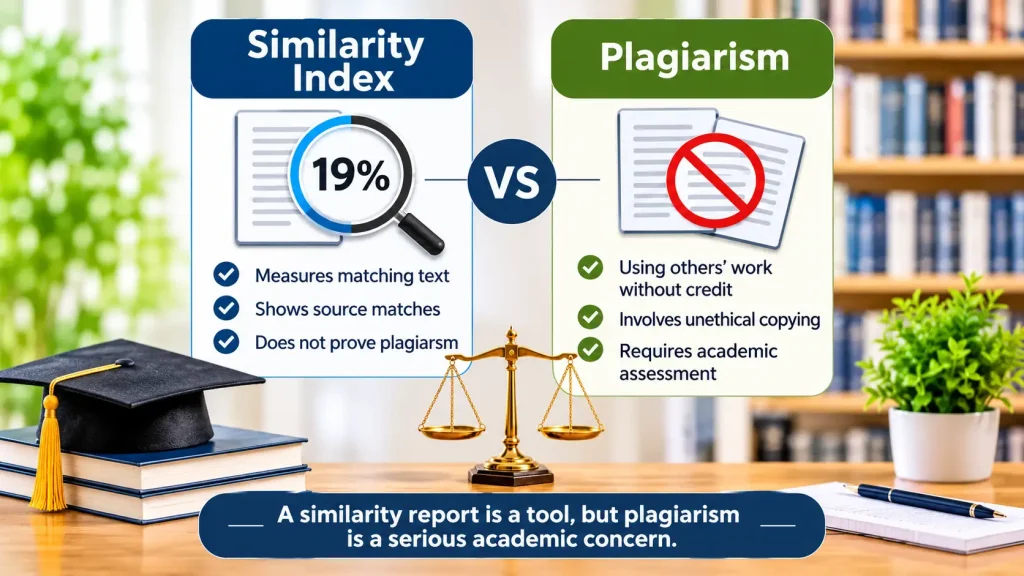
A similarity report provides useful information about matching text, but students need to understand its different elements before deciding whether revisions are necessary.
Here are the main areas to review.
1. Check the Overall Similarity Percentage
Start by identifying the overall similarity percentage. Compare it with the HEC guidelines and any additional requirements provided by your university.
Remember that a score of 19% or below does not automatically guarantee approval. It should be considered alongside the other conditions in the policy.
2. Review Individual Sources
Look at the sources contributing to the overall percentage. Pay particular attention to any individual source showing a match of 5% or more.
Check whether the matched material is properly quoted, referenced or otherwise appropriately acknowledged. A large match from one source may require attention even when the overall percentage appears acceptable.
3. Examine the Matching Passages
Open the highlighted sections and read them in context. Determine whether the match comes from:
- A properly cited quotation.
- A reference or bibliography entry.
- A standard academic phrase.
- A previously published passage.
- Text that has been copied without appropriate acknowledgement.
This review helps distinguish legitimate academic similarities from passages that may require correction.
4. Check the Findings and Conclusion Sections
Review the findings and conclusion separately, keeping the HEC’s 9% guidance in mind.
These sections should accurately reflect the research outcomes and the student’s interpretation. Pay particular attention to passages that closely resemble existing publications.
5. Verify Citations and References
Check whether every borrowed idea, quotation, statistic and research finding has been acknowledged appropriately.
Consistent referencing is essential for academic integrity. If you are unsure about citation styles or reference formatting, guidance on how to write a literature review can also help you understand how to discuss and acknowledge existing research.
How HEC Similarity Requirements Apply to Thesis Submission
The HEC plagiarism policy provides a framework for assessing academic originality, but students should also understand how their university applies these requirements.
For thesis and dissertations, the HEC policy identifies the PhD or Supervisory Committee as the Expert Committee responsible for considering the relevant similarity assessment.
This means that the similarity report should be reviewed by qualified academic experts rather than treated as an automatic pass-or-fail result.
Before submitting a thesis, students should consider the following:
- Check the latest thesis submission instructions issued by their university.
- Review the overall similarity index.
- Examine individual sources, especially those contributing 5% or more.
- Check similarity in the findings and conclusion sections.
- Verify quotations, citations and references.
- Discuss any unclear matches with the research supervisor.
- Confirm whether the university has additional formatting or submission procedures.
Universities may have their own administrative procedures and additional academic requirements. Students should therefore confirm the applicable rules with their department or research office rather than assuming that every institution follows identical submission steps.
If you are still developing your research structure, understanding how to write a research proposal can help you establish a clear research direction before moving towards the thesis stage.
What to Do If Your Thesis Has a High Similarity Score
A high similarity percentage does not mean that you should immediately rewrite your entire thesis. The first step is to understand why the report has identified matching material.
Consider the following practical steps.
Identify the Main Sources of Similarity
Review the sources contributing the largest percentages. Determine whether the matches come from quotations, references, commonly used expressions or passages that need revision.
Correct Missing Citations
If you have used another researcher’s ideas, findings or wording without proper acknowledgement, add the appropriate citation and reference.
Remember that changing a few words does not remove the responsibility to acknowledge the original source.
Improve Your Paraphrasing
When discussing existing research, explain the ideas in your own academic language while preserving their original meaning. Avoid simply replacing individual words with synonyms.
Effective paraphrasing demonstrates your understanding of the research and allows you to connect previous studies with your own argument.
Strengthen Your Own Analysis
A thesis should not rely entirely on summarising existing publications. Develop your own discussion by interpreting research findings, comparing relevant studies and explaining how the evidence relates to your research objectives.
For additional guidance on organising academic arguments and presenting research evidence, students can explore research methodology writing support.
Consult Your Research Supervisor
If a particular match is difficult to interpret, discuss it with your supervisor or the relevant academic committee. They can help determine whether the passage requires correction or whether the match is legitimate.
After making appropriate revisions, review the document again to confirm that the changes have improved its academic originality and referencing.
Students working on complex research projects may also find it useful to review the available thesis writing services for guidance on thesis structure, academic presentation and research development.
Practical Ways to Maintain Academic Integrity in Your Thesis
Maintaining academic integrity should be part of the entire research process, not something students consider only after receiving a similarity report.
The following practices can help:
- Maintain accurate research notes: Record the source details of articles, books and other materials while conducting research.
- Use proper citations: Acknowledge all borrowed ideas, data, quotations and findings according to the required referencing style.
- Paraphrase responsibly: Understand the original material before explaining it in your own words.
- Use quotations appropriately: Include direct quotations only when they are relevant and provide the necessary acknowledgement.
- Develop independent analysis: Present your own interpretation rather than depending excessively on the wording of existing research.
- Review your references: Ensure that in-text citations and the reference list are consistent.
- Check your academic writing: Review grammar, clarity, sentence structure and referencing before submission.
Students preparing research papers should also understand the importance of clear academic presentation. The research paper writing service page provides further information about research paper support, while editing and proofreading services can help with language clarity, consistency and academic presentation.
Frequently Asked Questions
1. What is the maximum similarity index allowed by the HEC?
The HEC Anti-Plagiarism Policy 2023 identifies 19% as an important similarity reference point. A score of 19% or below may receive the benefit of doubt, but it does not automatically establish that a thesis is free from plagiarism. Individual-source matches and other policy requirements must also be reviewed.
2. Is 19% similarity acceptable under HEC policy?
A similarity index of 19% or below may receive the benefit of doubt under the HEC policy. However, the report still requires academic interpretation. For example, an individual source contributing 5% or more may require closer examination, even when the overall score is below 19%.
3. What is the maximum similarity allowed from a single source?
The HEC policy identifies an individual-source match of 5% or more as requiring closer examination for possible plagiarism. Students should not interpret this as permission to copy up to 5% from one source. The nature and acknowledgement of the matching material must be assessed.
4. Does a similarity index automatically mean plagiarism?
No. A similarity index only identifies matching text. It may include properly cited quotations, references, common expressions and other legitimate material. Plagiarism is determined through an academic assessment of the matched content and its use.
5. What is the similarity limit for thesis findings and conclusion?
The HEC Anti-Plagiarism Policy 2023 states that similarity in the findings and conclusion should not exceed 9%. Students should review these sections carefully and ensure that their discussion reflects their own research outcomes and interpretation.
6. What does a thesis similarity report show?
A thesis similarity report identifies matching text and indicates the sources where the matches were found. It may show the overall similarity percentage, individual-source contributions and highlighted passages. The report helps academic reviewers investigate potential issues, but it does not independently determine whether plagiarism has occurred.
Conclusion
The HEC 19% similarity index is an important part of Pakistan’s academic originality guidelines, but it should not be treated as the only measure of plagiarism in a thesis. The HEC Anti-Plagiarism Policy 2023 also highlights the importance of individual-source matches and similarity in the findings and conclusion sections.
Students should understand that a similarity report is a tool for academic review, not an automatic judgement of their research. Proper citations, responsible paraphrasing, independent analysis and consultation with research supervisors remain essential throughout the thesis-writing process.
By understanding the HEC plagiarism policy and reviewing similarity reports carefully, research students can prepare more academically responsible thesis and approach submission with greater confidence.