
Clinical Psychology Research Topics: Ideas for Students and Researchers

Clinical psychology research explores how people experience psychological difficulties, how these difficulties affect everyday life, and how assessment and psychological interventions can support better outcomes. Choosing the right research topic is an important first step for college and university students preparing a thesis, dissertation, or independent research project.
This guide brings together carefully selected clinical psychology research topics across anxiety, depression, trauma, psychotherapy, emotional regulation, digital mental health, neuropsychology, addiction, and chronic illness. Each idea includes a possible research direction, research question, or methodology consideration to help you move beyond a broad subject and develop a focused, workable study.
Whether you are planning an undergraduate project, a Master’s thesis, an MPhil study, or doctoral research, consider your academic level, access to appropriate data, available time, and institutional ethics requirements before finalising a topic.
Key Takeaways
- Choose a specific, researchable problem rather than a broad clinical psychology area.
- Define the population, variables, and research context before writing your research question.
- Match the research design to the question you want to answer.
- Check whether you can ethically and practically access the participants or data required.
- Use appropriate, validated assessment measures and interpret screening results carefully.
- Adapt the scope and theoretical depth of your topic to your academic level.
What Is Clinical Psychology Research?
Clinical psychology research is the systematic study of psychological difficulties, mental health, assessment, psychological functioning, and interventions. It examines how psychological, behavioural, cognitive, biological, and social factors relate to mental health and how different approaches to assessment and treatment work in particular contexts.
Research in this field can investigate topics such as:
- Anxiety, depression, and mood-related symptoms.
- Trauma, stress, and psychological resilience.
- Psychotherapy processes and treatment outcomes.
- Personality, emotional regulation, and interpersonal functioning.
- Digital mental health tools and online interventions.
- Cognitive functioning and neuropsychological processes.
- Addiction, substance use, and relapse-related factors.
- Psychological adjustment to chronic physical illness.
Clinical psychology research does not always involve recruiting patients or conducting clinical assessments. Depending on the research question and university requirements, a project may use non-clinical participants, interviews, published literature, approved secondary datasets, or other suitable research methods.
Clinical Psychology Research Topics by Category
The following list of clinical psychology research topics focuses on specific research directions rather than broad subject labels. The ideas can be refined according to the population, setting, variables, and research design available to you.
1. Anxiety, Depression, and Mood-Related Symptoms
Anxiety and depression are important areas of clinical psychology research. Students can explore how psychological symptoms relate to sleep, academic pressure, emotional processes, and everyday functioning.
1. Academic Stress and Anxiety Symptoms Among University Students
Explore the relationship between perceived academic pressure and anxiety symptoms among university students. The study could examine whether workload, assessment pressure, or concerns about academic performance are associated with reported anxiety.
- Possible research question: Is perceived academic stress associated with anxiety symptoms among university students?
- Population: Undergraduate or postgraduate students.
- Variables: Perceived academic stress and self-reported anxiety symptoms.
- Possible method: Quantitative cross-sectional survey.
- Feasibility: Usually more accessible than research involving clinical patient groups, subject to university approval and appropriate measures.
2. Sleep Quality and Depressive Symptoms in Young Adults
This topic examines whether differences in sleep quality are associated with depressive symptoms in young adults. It can also consider sleep routines and daytime functioning.
- Possible research question: What is the relationship between sleep quality and depressive symptoms among young adults?
- Population: Young adults within a clearly defined age range.
- Variables: Sleep quality and depressive symptoms.
- Possible method: Quantitative correlational study using suitable self-report measures.
- Feasibility: Define the age range and avoid interpreting questionnaire scores as a clinical diagnosis.
3. Emotional Regulation and Anxiety Symptoms
Emotional regulation refers to the ways people understand, manage, and respond to their emotional experiences. A study could investigate whether particular regulation strategies are associated with anxiety symptoms.
- Possible research question: How are emotional regulation strategies associated with anxiety symptoms among university students?
- Population: University students or another clearly defined adult group.
- Variables: Emotional regulation strategies and anxiety symptoms.
- Possible method: Correlational survey.
- Feasibility: Select measures that are appropriate for the target population and research context.
4. Rumination and Depressive Symptoms in Adults
Rumination involves repeatedly thinking about distressing experiences, feelings, or problems. This topic could examine how rumination relates to depressive symptoms and psychological functioning.
- Possible research question: Is rumination associated with depressive symptoms among adults?
- Population: Adults recruited through an ethically approved process.
- Variables: Rumination and self-reported depressive symptoms.
- Possible method: Quantitative correlational research.
- Feasibility: Use careful, non-diagnostic language when interpreting symptom measures.
2. Trauma, Stress, and Psychological Resilience
Trauma and stress-related research examines how people respond to difficult experiences and what factors may be associated with psychological adjustment. Participant wellbeing and ethical safeguards are especially important in this area.
5. Childhood Adversity and Emotional Regulation in Adults
This study could explore whether reported childhood adversity is associated with emotional regulation patterns in adulthood.
- Possible research question: How is retrospectively reported childhood adversity associated with emotional regulation among adults?
- Population: Adults, recruited with appropriate ethical safeguards.
- Variables: Reported childhood adversity and emotional regulation.
- Possible method: Quantitative survey or qualitative interviews, depending on the research objective.
- Feasibility: Sensitive questions may cause distress. Participation should be voluntary, with suitable support and withdrawal procedures.
6. Social Support and Psychological Resilience
Social support may be an important factor in how people respond to stressful experiences. A research project could investigate the association between perceived support and resilience.
- Possible research question: Is perceived social support associated with psychological resilience among young adults?
- Population: Young adults or university students.
- Variables: Perceived social support and resilience.
- Possible method: Quantitative correlational study.
- Feasibility: Define the types of support being examined, such as family, friends, or institutional support.
7. Coping Strategies and Psychological Adjustment Following Trauma
This topic explores how individuals describe or report coping with difficult experiences and how different coping strategies relate to psychological adjustment.
- Possible research question: How do adults describe the coping strategies they use following a significant stressful experience?
- Population: Adults with relevant experiences, recruited through an approved process.
- Research concepts: Coping strategies, perceived support, and psychological adjustment.
- Possible method: Qualitative interviews or an appropriately designed survey.
- Feasibility: Requires careful recruitment, confidentiality, informed consent, and a plan for responding to participant distress.
3. Psychotherapy Processes and Treatment Outcomes
Psychotherapy research can examine how therapeutic relationships, treatment engagement, and intervention approaches relate to outcomes. A student project should have a realistic scope and should not claim that one treatment is superior without an appropriate comparative design.
8. Therapeutic Alliance and Psychotherapy Outcomes
The therapeutic alliance refers to the collaborative relationship between a client and therapist. Research could examine whether clients’ perceptions of this relationship are associated with reported progress during therapy.
- Possible research question: Is the perceived therapeutic alliance associated with self-reported psychotherapy outcomes?
- Population: Clients in an approved clinical or counselling setting, where access is permitted.
- Variables: Therapeutic alliance and selected outcome measures.
- Possible method: Quantitative correlational research.
- Feasibility: Requires permission from the relevant service and appropriate supervision. Students should not independently access confidential clinical records.
9. CBT-Based Approaches and Anxiety-Related Outcomes
Cognitive behavioural therapy (CBT) is a structured psychological approach used in several mental health contexts. A research project could examine published evidence or approved outcome data relating to CBT-based interventions and anxiety symptoms.
- Possible research question: What does published research report about CBT-based interventions for reducing anxiety symptoms in adults?
- Population or material: Published studies involving adults with clearly defined anxiety-related concerns.
- Possible method: Systematic or structured literature review.
- Feasibility: Define inclusion criteria, databases, and outcome measures before beginning the review.
10. Psychotherapy Engagement and Treatment Completion
This topic examines factors that may be associated with continued participation in psychotherapy, such as perceived support, practical barriers, expectations, and treatment experiences.
- Possible research question: What factors do adult service users identify as influencing their continued engagement with psychotherapy?
- Population: Adults who have experience of an appropriate psychological service.
- Research concepts: Engagement, perceived barriers, expectations, and treatment experience.
- Possible method: Qualitative interviews or analysis of approved, anonymised service data.
- Feasibility: Access to service users or records requires formal permission and safeguards.
4. Personality, Emotional Regulation, and Psychological Functioning
Personality and emotional processes can provide useful directions for studying psychological distress and interpersonal functioning. Research questions should be specific enough to measure or explore clearly.
11. Perfectionism and Psychological Distress Among Postgraduate Students
This study could examine whether particular dimensions of perfectionism are associated with psychological distress among postgraduate students.
- Possible research question: Is maladaptive perfectionism associated with psychological distress among postgraduate students?
- Population: Master’s, MPhil, or doctoral students.
- Variables: Perfectionism and self-reported psychological distress.
- Possible method: Quantitative correlational survey.
- Feasibility: Distinguish between different dimensions of perfectionism instead of treating it as a single, simple trait.
12. Emotional Regulation and Interpersonal Difficulties
This topic explores whether difficulties managing emotional responses are associated with challenges in interpersonal relationships.
- Possible research question: How are emotional regulation difficulties associated with self-reported interpersonal problems among adults?
- Population: Adults or university students.
- Variables: Emotional regulation difficulties and interpersonal functioning.
- Possible method: Quantitative survey or mixed-methods study.
- Feasibility: Define the interpersonal outcomes being studied, such as conflict, communication difficulties, or relationship satisfaction.
13. Self-Criticism and Psychological Distress
Self-criticism involves a negative or harsh evaluation of oneself. Research could examine its relationship with psychological distress in a defined population.
- Possible research question: Is self-criticism associated with psychological distress among university students?
- Population: University students or adults.
- Variables: Self-criticism and psychological distress.
- Possible method: Quantitative correlational design.
- Feasibility: Choose measures that distinguish self-criticism from related concepts such as low self-esteem.
5. Digital Mental Health and Online Interventions
Digital mental health research considers how technology is used to deliver, support, or monitor psychological interventions. It is important to distinguish between user experiences, intervention effectiveness, and general patterns of technology use.
14. Online CBT and Anxiety Symptoms
This topic could examine the evidence for online CBT programmes designed to support adults experiencing anxiety symptoms.
- Possible research question: What outcomes have published studies reported for online CBT interventions targeting anxiety symptoms in adults?
- Research material: Peer-reviewed intervention studies.
- Possible method: Systematic or structured literature review.
- Feasibility: Compare similar populations and outcome measures, and distinguish guided programmes from self-guided tools.
15. Social Media Use and Psychological Distress
A study could investigate whether patterns of social media use are associated with psychological distress in young adults. It should define the type of use rather than relying only on total screen time.
- Possible research question: How are different patterns of social media use associated with psychological distress among young adults?
- Population: Young adults or university students.
- Variables: Social media use patterns and self-reported psychological distress.
- Possible method: Quantitative survey.
- Feasibility: Avoid assuming that social media use causes distress when using a cross-sectional correlational design.
16. User Experiences of Digital Mental Health Applications
This research direction focuses on how people experience mental health applications, including perceived usefulness, accessibility, privacy concerns, and barriers to continued use.
- Possible research question: How do adult users describe the benefits and limitations of digital mental health applications?
- Population: Adults who have used a defined type of mental health application.
- Research concepts: Usability, perceived usefulness, privacy, and engagement.
- Possible method: Qualitative interviews or mixed-methods research.
- Feasibility: Define the type of application and do not treat user satisfaction as proof of clinical effectiveness.
6. Neuropsychology, Addiction, and Health Psychology
These topics connect psychological functioning with cognitive processes, substance use, and physical health. Some may require specialist supervision, clinical access, or approved datasets.
17. Working Memory and Anxiety Symptoms
Working memory is involved in temporarily holding and using information. This topic could investigate whether anxiety symptoms are associated with performance on an appropriate working-memory task.
- Possible research question: Is self-reported anxiety associated with working-memory task performance among university students?
- Population: University students or another defined adult group.
- Variables: Anxiety symptoms and working-memory performance.
- Possible method: Quantitative study using an appropriate cognitive task and validated symptom measure.
- Feasibility: Consider testing conditions, task suitability, and possible confounding factors such as sleep.
18. Psychological Factors Associated With Substance Use Relapse
This topic explores psychological and contextual factors that may be associated with relapse experiences among people receiving substance-use support.
- Possible research question: What psychological and social factors do adults in recovery identify as relevant to relapse experiences?
- Population: Adults with relevant recovery experiences, recruited through an approved service or research pathway.
- Research concepts: Coping, perceived support, stress, and recovery experiences.
- Possible method: Qualitative interviews or analysis of approved anonymised data.
- Feasibility: Requires specialist oversight, careful safeguarding, confidentiality, and ethical recruitment.
19. Psychological Adjustment Among Adults Living With Chronic Illness
Living with a long-term physical health condition may involve emotional, social, and practical challenges. Research could explore how adults describe psychological adjustment and perceived support.
- Possible research question: How do adults living with a chronic physical health condition describe factors that support their psychological adjustment?
- Population: Adults living with a clearly defined chronic condition.
- Research concepts: Adjustment, coping, social support, and wellbeing.
- Possible method: Qualitative interviews or a quantitative survey.
- Feasibility: Recruitment may require healthcare-service permission. Avoid collecting unnecessary medical information.
20. Health Anxiety and Healthcare-Seeking Behaviour
This topic examines how health-related worry may be associated with decisions to seek information or professional healthcare.
- Possible research question: How is health anxiety associated with healthcare-seeking behaviour among adults?
- Population: Adults from a clearly defined community or university population.
- Variables: Health anxiety and self-reported healthcare-seeking behaviour.
- Possible method: Quantitative survey.
- Feasibility: Define healthcare-seeking behaviour carefully and avoid interpreting survey responses as a diagnosis.
Current and Emerging Research Topics in Clinical Psychology
Clinical psychology continues to develop as researchers investigate new ways to understand psychological difficulties, improve assessment, and evaluate interventions. The following are useful directions for students interested in current research topics in clinical psychology. They should be treated as developing research areas, not as proof that every proposed approach is already established or effective.
1. Artificial Intelligence in Psychological Assessment
AI-based systems are being explored for tasks such as organising information, identifying patterns in language, and supporting aspects of digital assessment. Research could investigate their accuracy, fairness, privacy implications, and limitations.
Possible research question: What are the perceived benefits and concerns associated with AI-supported mental health assessment among psychology professionals?
A suitable project might be a literature review, professional interview study, or analysis of published validation research. Avoid treating an AI-generated result as a clinical diagnosis.
2. Culturally Adapted Psychological Interventions
Psychological interventions may need to account for language, cultural expectations, family structures, social context, and local understandings of mental health. This area can be particularly relevant when considering whether an intervention or assessment tool is suitable for a different population.
Possible research question: What factors should be considered when adapting a psychological intervention for adults from a different cultural or linguistic background?
Students can explore this through a literature review or, where approval and expertise are available, qualitative research with relevant professionals or service users.
3. Telepsychology and Online Therapeutic Relationships
Online psychological services raise questions about therapeutic communication, privacy, accessibility, engagement, and the experience of receiving support remotely.
Possible research question: How do adults describe the advantages and challenges of receiving psychological support through online sessions?
A qualitative interview study or literature review may be appropriate. Any research involving service users should be conducted with the relevant permissions and safeguards.
4. Transdiagnostic Approaches to Psychological Difficulties
Transdiagnostic research examines processes that may be relevant across more than one mental health condition, such as avoidance, rumination, emotional regulation, or difficulties tolerating distress.
Possible research question: How is experiential avoidance associated with psychological distress across a defined adult population?
A focused review or correlational study could examine one clearly defined process. Students should explain the theoretical framework and avoid assuming that different conditions are interchangeable.
5. Digital Interventions and Self-Management Support
Digital tools may provide structured psychological exercises or self-management support. However, their effectiveness depends on the intervention, population, outcome, and quality of evidence. For example, the World Health Organization’s 2023 guidance says certain evidence-based digital interventions may be considered as support for people experiencing suicidal thoughts, but the recommendation is conditional and the certainty of evidence is low. This is an important reminder to evaluate digital interventions carefully rather than describing them as proven replacements for professional care. World Health Organization+1
Possible research question: What does current research indicate about the acceptability and reported outcomes of digital self-management interventions for adults experiencing psychological distress?
A structured literature review can be a practical way to examine this topic without independently delivering an intervention.
Clinical Psychology Thesis and Dissertation Topics by Academic Level
The same broad research area can be developed into different projects depending on the student’s academic level. A suitable topic is not determined by its title alone; it also depends on theoretical depth, research design, sample access, analysis requirements, and the time available.
These examples show how one subject—emotional regulation—can be developed at different levels.
| Academic level | Example research direction | Expected scope |
|---|---|---|
| Undergraduate / BS | Emotional regulation strategies and perceived stress among university students | A focused study using a manageable sample and established measures |
| Master’s | Emotional regulation and anxiety symptoms among postgraduate students | A more developed theoretical framework and clearer analysis plan |
| MPhil | Emotional regulation as a potential factor in the relationship between perceived stress and psychological distress | A stronger rationale, more detailed literature review, and carefully justified analytical approach |
| PhD / Doctoral | Development and evaluation of a culturally adapted emotional regulation intervention for a defined population | Original contribution, substantial theoretical development, rigorous design, and appropriate oversight |
Undergraduate and BS Clinical Psychology Thesis Topics
Undergraduate projects usually benefit from a clearly defined population, a manageable research question, and a method that can be completed within the available academic period.
Possible directions include:
- Perceived academic stress and anxiety symptoms among undergraduate students.
- Sleep quality and emotional regulation in young adults.
- Perceived social support and psychological resilience among university students.
- Self-criticism and self-reported psychological distress in adults.
- Social media use patterns and perceived wellbeing among young adults.
A focused survey or literature review may be more practical than a project requiring access to clinical patients.
Master’s Clinical Psychology Thesis Topics
Master’s research can involve a more developed theoretical framework, a narrower population, and more detailed analysis.
Possible directions include:
- The relationship between rumination and depressive symptoms among postgraduate students.
- Emotional regulation strategies and interpersonal difficulties among adults.
- Perfectionism and psychological distress in Master’s students.
- Experiences of online psychological support among adult users.
- Coping strategies and perceived support among adults living with a chronic illness.
Students should demonstrate why the selected variables matter and how the chosen method can answer the research question.
MPhil Clinical Psychology Thesis Topics
An MPhil project may require a stronger theoretical contribution, more critical engagement with existing studies, and a carefully justified research design.
Possible directions include:
- The role of perceived social support in the relationship between stress and psychological resilience.
- Emotional regulation difficulties and interpersonal functioning in a defined adult population.
- Cultural considerations in the use of psychological assessment measures.
- A qualitative investigation of barriers to psychotherapy engagement.
- A systematic review of digital interventions for a clearly defined psychological concern.
The topic should be sufficiently focused to allow meaningful analysis while offering more depth than a basic descriptive project.
PhD and Doctoral Clinical Psychology Dissertation Topics
Doctoral research generally requires a substantial original contribution. Depending on the university and research area, this may involve developing or testing a theoretical model, evaluating an intervention, validating a measure, or conducting a complex longitudinal or mixed-methods study.
Possible directions include:
- Development and evaluation of a culturally adapted psychological intervention for a defined population.
- Longitudinal investigation of emotional regulation and psychological adjustment in adults.
- Psychometric evaluation of a psychological measure for a specific language or cultural context.
- A mixed-methods study of engagement and outcomes in a defined digital mental health programme.
- Investigation of transdiagnostic psychological processes across clearly specified clinical groups.
These are starting directions, not ready-made doctoral proposals. A doctoral topic needs a detailed literature review, a defensible research gap, specialist supervision, and a feasible plan for recruitment, measurement, analysis, and ethics approval.
Students looking for more detailed academic-level guidance can explore the resources on Master’s thesis help, MPhil thesis help, and PhD thesis help. The requirements of the relevant university should always take priority.
How to Choose a Clinical Psychology Research Topic
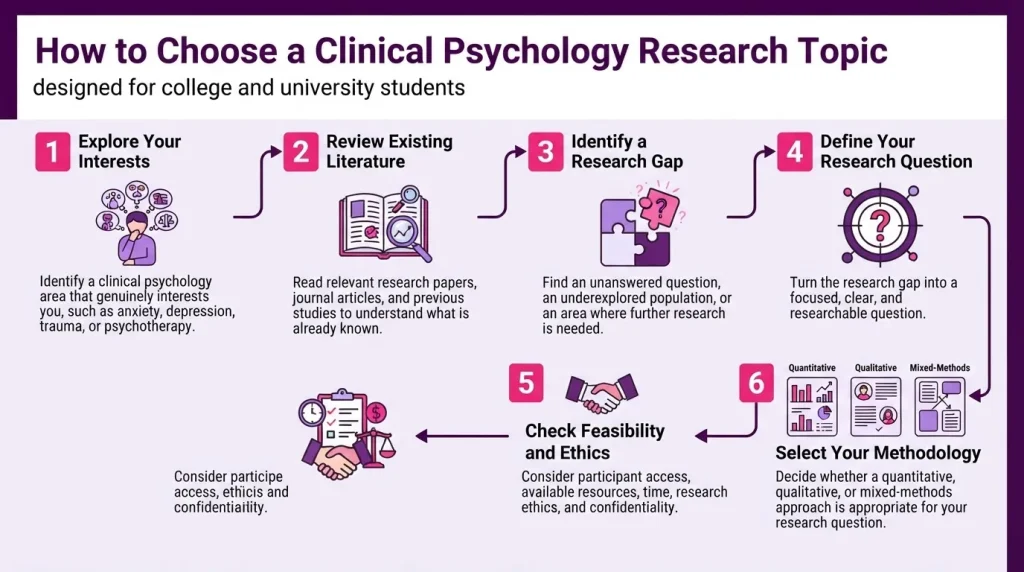
A good topic should be academically relevant, specific enough to investigate, and realistic within your available resources. Use the following steps to turn a broad interest into a workable research project.
1. Choose a Specific Area of Interest
Start with a broad clinical psychology area, such as anxiety, trauma, psychotherapy, emotional regulation, or digital mental health. Select an area that genuinely interests you and is relevant to your programme.
For example, instead of choosing anxiety, you might focus on anxiety symptoms among university students.
2. Identify a Research Problem
A research area becomes more useful when you identify a particular issue that needs investigation.
For example:
- Broad area: Anxiety.
- More focused issue: Anxiety symptoms among university students.
- More specific direction: The relationship between perceived academic stress and anxiety symptoms among undergraduate students.
This gives the project a defined context and a clearer direction.
3. Review Existing Literature
Read relevant journal articles, systematic reviews, academic books, and credible research publications. Your review should help you understand what has already been studied, which populations and methods have been used, and where further investigation may be justified.
A useful literature review does more than summarise articles. It compares findings, evaluates research methods, identifies limitations, and builds a rationale for your proposed study. For practical guidance, see how to write a literature review.
4. Identify a Research Gap Carefully
A research gap does not necessarily mean that nobody has studied the subject. It may involve:
- A population that has received limited attention in the literature you reviewed.
- Findings that differ across studies.
- A measurement or methodological limitation.
- A context that has not been sufficiently examined.
- A question that previous research has not answered clearly.
Do not claim that a topic is unexplored simply because you have found only a few articles. Search relevant academic databases and document how you reached your conclusion.
5. Define the Population and Variables
Specify who or what your study will examine. If you are conducting a quantitative study, identify the main variables. If you are conducting qualitative research, define the experiences or perspectives you want to explore.
For example:
- Population: Undergraduate university students.
- Variable 1: Perceived academic stress.
- Variable 2: Self-reported anxiety symptoms.
- Research direction: The association between academic stress and anxiety symptoms.
A clear population and research focus make it easier to select an appropriate method.
6. Develop a Focused Research Question
A research question should communicate exactly what the project will investigate.
Compare these examples:
- Too broad: How does anxiety affect people?
- More focused: Is perceived academic stress associated with anxiety symptoms among undergraduate students?
- Qualitative alternative: How do undergraduate students describe academic experiences that they perceive as contributing to anxiety?
The wording should match the research design. A correlational study can investigate an association, but it cannot by itself establish that one variable causes another.
7. Check Access to Participants or Data
Before finalising a topic, consider whether you can realistically obtain the required data. Research involving clinical patients, therapy records, or sensitive mental-health information may require service-level permission, specialist supervision, and formal ethics approval.
If access is uncertain, consider an alternative such as:
- A study involving a suitable non-clinical adult population.
- A literature review.
- An approved secondary-data project.
- Interviews with qualified professionals, where appropriate permission is available.
8. Select a Suitable Methodology
Your research method should answer the question—not simply be selected because it is familiar or convenient. Decide whether a quantitative, qualitative, mixed-methods, or review-based approach is most appropriate.
9. Evaluate Time, Resources, and University Requirements
Check your submission deadline, supervisor’s guidance, access to research tools, analysis skills, participant recruitment requirements, and institutional formatting rules. A topic that is interesting but impossible to complete responsibly is not a suitable research choice.
10. Prepare the Research Proposal
Once the topic and question are clear, prepare a proposal that explains the research problem, rationale, literature, objectives, methodology, ethical considerations, and expected contribution. The guide on how to write a research proposal explains the main stages, and the research proposal sample format can help you understand how a proposal is organised.
Research Methodology for Clinical Psychology Topics
The methodology should be selected according to the research question, available evidence, participant access, and academic requirements.
| Research approach | What it investigates | When it may be suitable |
|---|---|---|
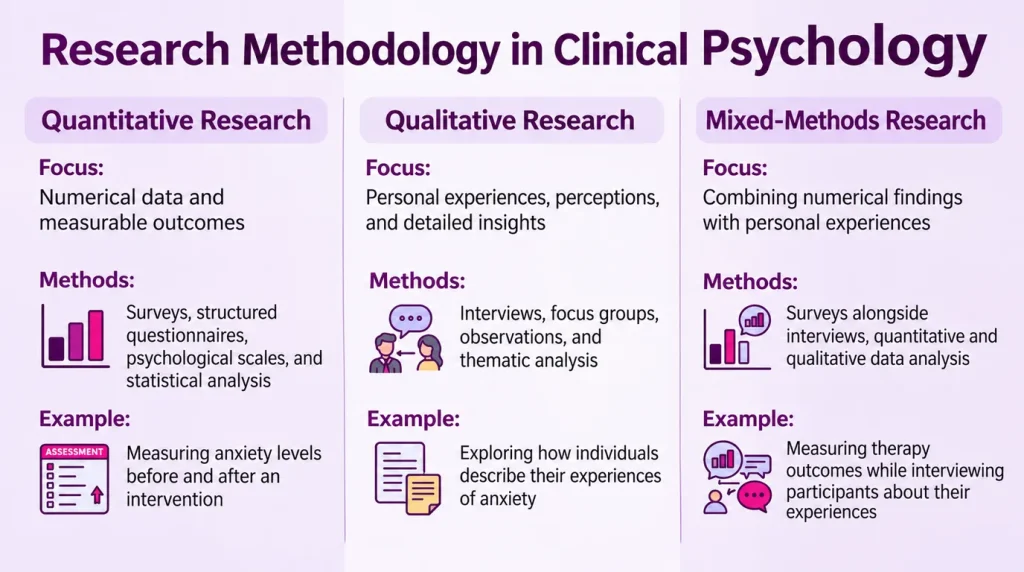
| Quantitative research | Relationships, differences, patterns, or measurable outcomes | When variables can be measured using appropriate tools or datasets |
| Qualitative research | Experiences, perceptions, meanings, and perspectives | When the study aims to understand how people describe an experience |
| Mixed-methods research | A combination of numerical findings and qualitative insights | When both measurable patterns and detailed experiences are important |
| Case study | A detailed examination of a defined case or context | When access, consent, confidentiality, and supervision requirements can be met |
| Systematic or structured literature review | Findings across a defined body of published research | When the project aims to synthesise existing evidence |
| Secondary-data research | Data previously collected for an approved purpose | When a suitable dataset is accessible and its use is permitted |
Quantitative Research
Quantitative studies use numerical data to investigate variables, patterns, associations, or differences. For example, a student might examine whether perceived academic stress is associated with self-reported anxiety symptoms.
The research plan should specify the sample, measures, data collection procedure, and statistical analysis. If the design is cross-sectional and correlational, report associations rather than causal effects.
Qualitative Research
Qualitative studies explore how people understand and describe their experiences. Interviews, focus groups, and other approved qualitative approaches may be appropriate.
For example, a study could explore how adults describe their experiences of accessing online psychological support. Researchers should plan how they will protect participants’ identities and handle sensitive disclosures.
Mixed-Methods Research
Mixed-methods research combines quantitative and qualitative approaches. A project might first examine patterns in survey responses and then use interviews to understand participants’ experiences in greater depth.
This approach can be valuable, but it requires sufficient time, skills, and a clear plan for integrating the two forms of evidence.
Systematic and Literature Reviews
A literature review can be an appropriate research project when access to participants is limited or the research question concerns existing evidence. A systematic review requires a defined question, transparent search strategy, inclusion and exclusion criteria, and a reproducible selection process.
Selecting Psychological Assessment Measures
Choosing a questionnaire or assessment tool requires more than finding one that is easy to access. Researchers should consider what the instrument measures, evidence of reliability and validity, sensitivity to differences or change, and whether its psychometric properties apply to the intended population and context. Cultural and language suitability also matter. Cambridge University Press+1
A screening measure should not be presented as a clinical diagnosis. Students should follow the instrument’s permitted use, scoring guidance, licensing requirements, and supervisor’s advice. Further guidance on research methodology can help when planning the design and analysis of a study.
Ethical Considerations in Clinical Psychology Research
Clinical psychology research may involve sensitive personal experiences, mental-health information, or participants who could be vulnerable to distress. Ethical planning should therefore be part of topic selection—not something added only when the project is ready for submission.
Informed Consent
Participants should receive understandable information about the study’s purpose, procedures, expected time, possible risks, confidentiality limits, and their right to decline or withdraw, in line with the applicable ethics requirements. The APA’s research standards discuss informed consent and institutional approval for research involving human participants. https://www.apa.org+1
Confidentiality and Privacy
Collect only the information required for the research. Store data securely, restrict access appropriately, and remove identifying details from reports wherever possible. Explain any limits to confidentiality before participation.
Sensitive Mental-Health Information
Questions about trauma, self-harm, substance use, or psychological distress can be upsetting. Researchers should consider whether the questions are necessary, whether participants can skip them, and what support or referral information may be appropriate.
Research With Vulnerable Participants
Research involving children, people receiving clinical care, or individuals who may have difficulty giving informed consent requires additional safeguards. Students should not independently recruit or assess clinical patients without the necessary permissions, qualifications, and supervision.
Institutional Ethics Approval
Follow your university’s ethics review process and any relevant local requirements before recruiting participants or collecting data. Approval should be obtained before starting activities that require it, and the study should follow the approved protocol. https://www.apa.org+1
Responsible Use of Psychological Tests
Use assessment tools only when you have the necessary permission and competence. Check their suitability for the population, language, and research purpose. Do not interpret a screening score as a diagnosis or make clinical decisions beyond your training and role.
Common Mistakes to Avoid When Choosing a Topic
A strong research idea can become difficult to complete if the topic or design is poorly defined. Watch out for these common problems:
- Choosing a topic that is too broad: Narrow the subject to a specific problem, population, and context.
- Writing a title before identifying the research problem: Establish what you want to investigate before finalising the wording.
- Assuming correlation proves causation: Use language that accurately reflects your study design.
- Selecting inaccessible participants: Check recruitment permissions and practical access before committing to a clinical population.
- Using unsuitable questionnaires: Review validity, reliability, cultural suitability, and permitted use.
- Claiming a research gap without sufficient evidence: Review relevant studies and explain the limitation or unanswered question you have identified.
- Ignoring ethical approval: Confirm institutional requirements before collecting data.
- Trying to cover too many variables: A focused project is usually easier to design, analyse, and explain.
- Choosing a method that does not answer the question: Let the research question guide the methodology.
- Treating a topic list as a finished proposal: A title still needs a rationale, literature review, objectives, method, and feasibility assessment.
Frequently Asked Questions
1. What are some good clinical psychology research topics for students?
Good topics are specific, relevant, and feasible. Examples include academic stress and anxiety symptoms among university students, sleep quality and depressive symptoms in young adults, emotional regulation and interpersonal difficulties, and perceived social support and psychological resilience. The best choice depends on your research question, academic level, available evidence, and access to data.
2. How do I choose a clinical psychology thesis topic?
Start with a clinical psychology area that interests you, identify a research problem, and review relevant academic literature. Then define your population, variables or experiences, research question, methodology, and ethical requirements. Confirm that the project is achievable within your university’s time and resource limits.
3. What is the difference between clinical psychology thesis topics and dissertation topics?
The terms thesis and dissertation are used differently across universities and countries. In some systems, a thesis refers to a Master’s or research degree project, while a dissertation may refer to doctoral research; other institutions use the terms differently. Follow your university’s terminology and focus on the required academic scope, originality, and research depth.
4. Can I find clinical psychology thesis PDFs online?
Some universities and academic repositories provide access to completed theses and dissertations. Availability depends on the institution, repository, and author’s access settings. Use these documents to understand research structure, methods, and referencing—not to copy their content. Check the repository’s terms and cite any material you use.
5. What methodology is best for clinical psychology research?
There is no single best methodology. Quantitative methods can examine measurable variables and associations; qualitative methods can explore experiences and perspectives; mixed methods can combine both. Literature reviews and approved secondary-data studies may also be suitable. Choose the approach that directly answers your research question.
6. Can undergraduate students conduct clinical psychology research?
Yes. Undergraduate students can investigate suitable clinical psychology questions, provided the scope matches their training and university requirements. Many projects use non-clinical adult populations, published literature, or approved datasets. Research involving patients or sensitive clinical information requires the appropriate permissions, supervision, and ethical safeguards.
Conclusion
The strongest clinical psychology research topics are not necessarily the most complicated or unusual. They are the ones that address a clear research problem, use an appropriate method, and can be investigated responsibly with the time, resources, and access available.
Start with a focused area such as anxiety, emotional regulation, trauma, psychotherapy, or digital mental health. Review existing studies, narrow your population and research question, and check feasibility and ethics before finalising your topic. A carefully planned project is more valuable than a broad title that cannot be investigated properly.
If you need support with planning your research, structuring a thesis, or preparing a proposal, Quick Assignment Help provides academic guidance for college and university-level work. You can explore thesis writing services, dissertation writing support, and academic editing and proofreading according to your project requirements.